Access Pakistan's most reliable Live Tracker. Verify ownership details, track CNIC registrations, and identify network providers securely.
Get instant access to SIM owner details, CNIC tracking, and live network updates directly from your mobile phone. Fast, secure, and completely free.
Read the latest news, guides, and updates from our blog.
Important information regarding SIM ownership and PTA regulations.
Key insights into mobile networks, PTA enforcements, and digital security in Pakistan.
Finding reliable information about SIM ownership and network details in Pakistan has never been easier. With the advanced capabilities of cnic.sims.pk, users can instantly access publicly available telecom records through a secure and streamlined interface.
Whether you are trying to verify the identity behind an unknown caller, check how many active connections are registered against your own CNIC, or track a specific mobile network provider, our live tracker provides rapid and accurate results. By simply entering a mobile number or a 13-digit CNIC, the system retrieves the latest associated records from the database in real-time.
Our platform prioritizes your digital safety. We ensure that all tracking and verification requests are processed instantly without storing your personal queries, offering a safe, free, and lawful method to check SIM owner details across all major Pakistani networks including Jazz, Telenor, Zong, Ufone, and Onic.
Identify the network operator of any Pakistani mobile number by its first 4 digits.
Experience the most powerful and accurate SIM database search engine available.
Our optimized servers fetch records from the live database in milliseconds without any delays.
Continuously updated records ensuring you get the most recent and accurate ownership details.
No hidden charges, no premium subscriptions. Complete access to telecom records entirely free of cost.
Supports comprehensive lookups across all Pakistani operators including Jazz, Zong, Telenor, and Ufone.
Compatible with all major telecom operators
Track any number in three simple steps.
Choose between searching by a specific Mobile Number or a 13-digit CNIC.
Input the details in the search box above. Ensure you enter the digits correctly without dashes.
Our system instantly fetches the name, address, and network details from the live database.
We take your privacy seriously. All data transmitted through our portal is secured using advanced 256-bit SSL encryption. We adhere strictly to local telecommunication policies and do not store any logs of your search queries.
See what users across Pakistan are saying about our SIM tracking service.
"I was getting strange calls and used this tracker to identify the network and name. It worked instantly! Best free tool available online right now."
"Checked my CNIC to see how many SIMs were registered under my name. The data was 100% accurate and helped me block an unauthorized number."
"Very fast and completely free. I love the new interface, it looks so premium and works flawlessly on my mobile phone. Highly recommended!"
The Pakistan Telecommunication Authority (PTA) is the primary regulatory body responsible for managing and overseeing the establishment, operation, and maintenance of telecommunications systems in Pakistan. One of its most critical mandates is ensuring that every active SIM card in the country is correctly registered to a verified citizen.
In the past, the lack of a centralized and strict SIM registration system led to the widespread use of unregistered and untraceable mobile numbers. These numbers were frequently misused in fraudulent activities, spamming, and even severe criminal enterprises. To combat this, the PTA introduced a robust regulatory framework that limits the number of SIMs an individual can own and mandates strict identification protocols.
Today, owning a SIM card in Pakistan means you are legally responsible for any communication that originates from that number. This makes it absolutely vital for every citizen to occasionally check their SIM owner details and ensure no unauthorized connections are active under their Computerized National Identity Card (CNIC). Platforms like ours bridge the gap between complex regulatory databases and the common user, providing a simplified gateway to this crucial public data.
The Biometric Verification System (BVS) was a watershed moment in Pakistan's telecom history. Implemented rigorously following national security directives, it completely eliminated the concept of "anonymous" mobile connections.
Before BVS, one could purchase a SIM card simply by providing a photocopy of a CNIC. This loophole was heavily exploited. With the introduction of BVS, every telecom operator—whether it's Jazz, Telenor, Zong, or Ufone—must physically verify the thumbprint of the purchaser against the live database maintained by NADRA (National Database and Registration Authority).
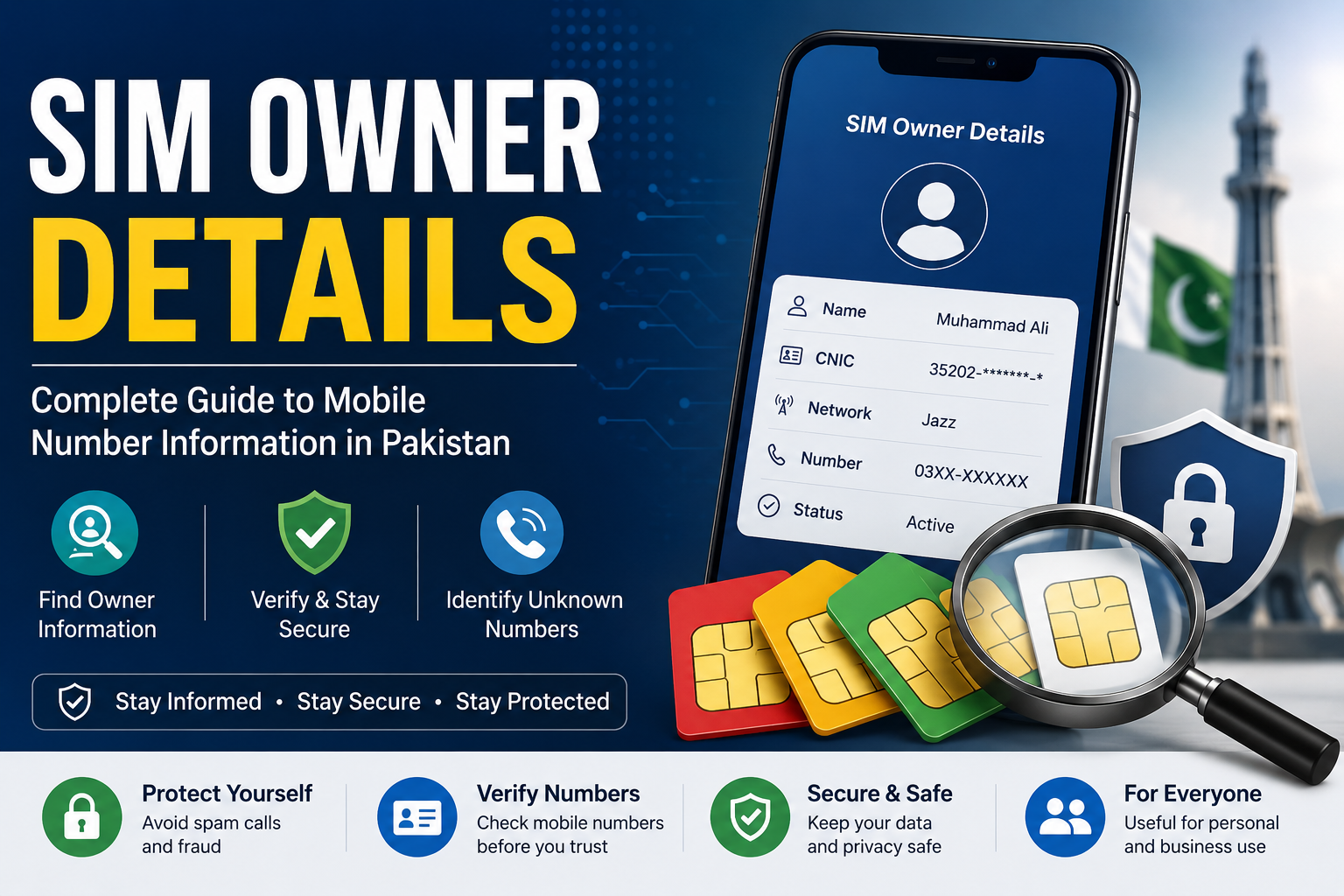
This system ensures that SIM owner details are 100% accurate. When you use our tracker to check a number, the name and CNIC you receive are backed by this biometric layer of security. However, despite these strict measures, scammers sometimes use manipulation techniques (like taking thumbprints under false pretenses) to register illegal SIMs. This is why conducting a regular CNIC SIM check is highly recommended to protect your digital identity.
Losing a mobile phone is stressful, but the real danger lies in losing the SIM card inside it. Because your SIM is intrinsically tied to your CNIC, any illegal activity conducted using your lost SIM will trace directly back to you in the PTA database.
Unauthorized SIMs—numbers operating under someone else's name without their knowledge—pose a significant threat to national security and individual safety. These connections are the primary tools used in financial fraud, kidnapping for ransom, and coordinated cyber-terrorism.
The PTA, in collaboration with the Federal Investigation Agency (FIA), actively hunts down illegal SIM sellers. However, the first line of defense is the citizen. By checking your SIM owner details, you act as a firewall against these threats. If you discover an extra SIM on your CNIC via our search tool, reporting it not only saves you from potential legal trouble but actively contributes to a safer telecommunications environment in Pakistan.
Pakistan's telecommunication sector has experienced explosive growth over the last decade. Moving from basic 2G voice services, the introduction of 3G and 4G LTE revolutionized how Pakistanis interact with the internet. Today, we are on the cusp of the 5G revolution.
As data speeds increase, so does the sheer volume of mobile subscriptions. Networks like Jazz and Zong have heavily invested in expanding their 4G footprints, even to remote areas. This massive influx of new connections means the PTA database is constantly expanding. Managing the SIM owner details of over 190 million active connections requires state-of-the-art infrastructure. Tools like our SIM tracker utilize optimized API queries to sift through this immense volume of data instantly, delivering precise ownership records regardless of the network's size.
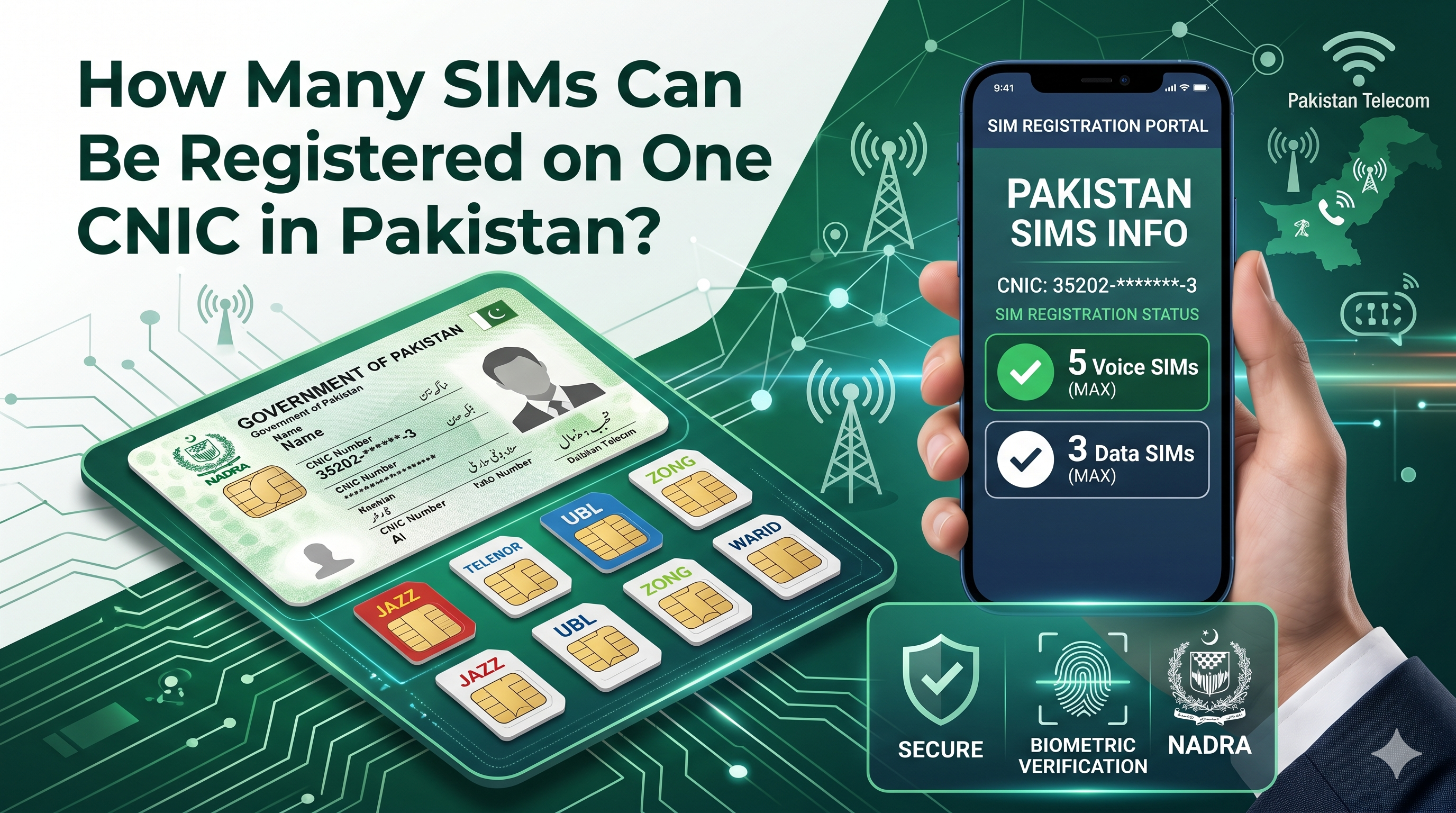
Every Pakistani citizen is allowed a maximum of 5 Voice SIMs and 3 Data SIMs on a single CNIC. Exceeding this limit is not possible through legal channels. To verify your current count, you can use our dedicated CNIC search feature.
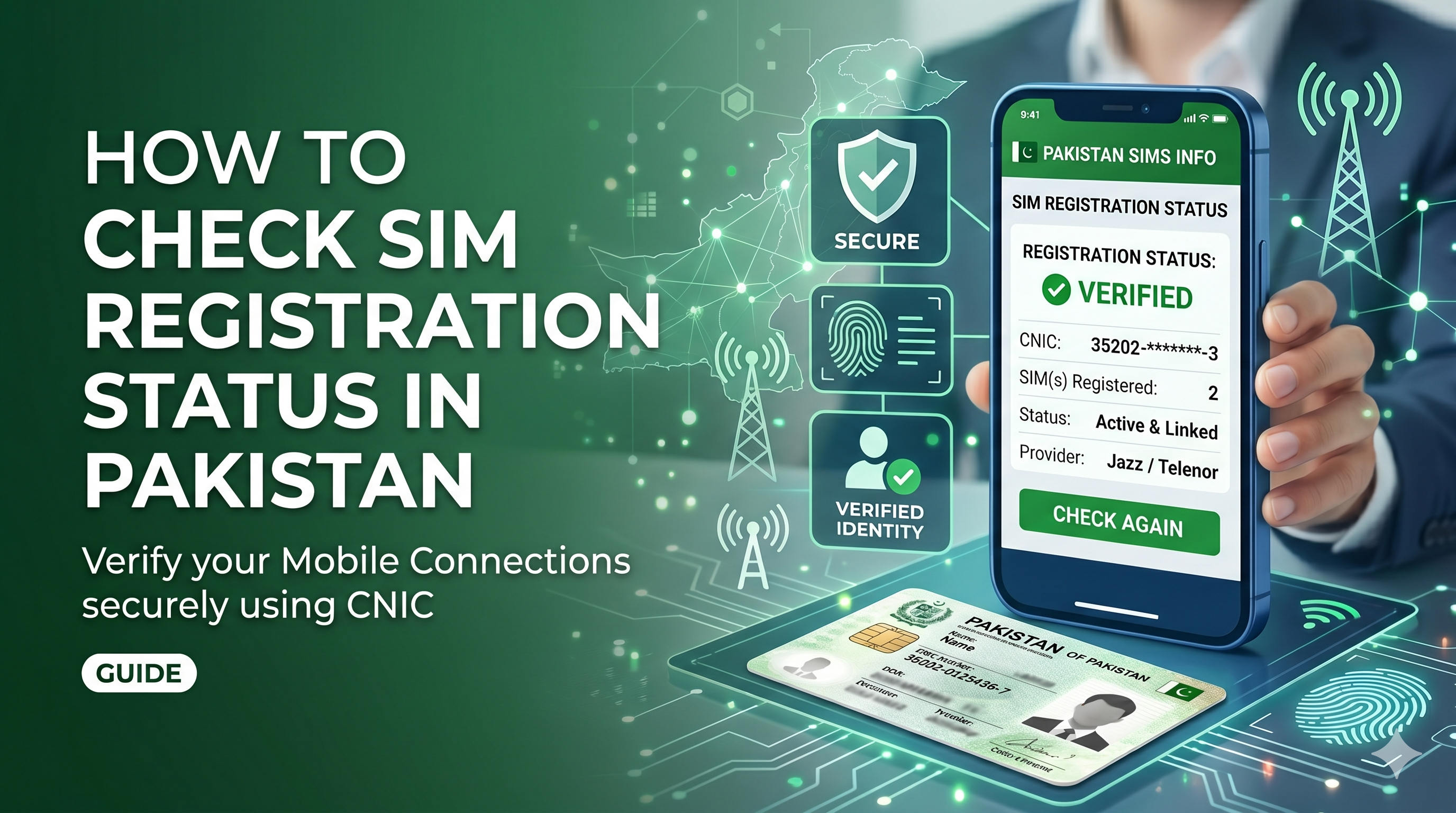
Simply toggle to the "CNIC No" tab on our homepage, enter your 13-digit ID card number without dashes, and hit search. The system will display the exact number of SIMs active on every network.
Alternatively, you can send your CNIC number (without dashes) via SMS to 668. PTA will reply with a breakdown of SIMs registered to your CNIC per operator.
Pakistan's telecom market is dominated by four major players, each offering unique strengths to their consumer base:
Regardless of which network an individual uses, their SIM owner details are centrally synced. This is why our tool can universally track any number from `0300` to `0349` without needing separate databases for each company.
Under the Prevention of Electronic Crimes Act (PECA), SIM fraud is treated as a severe criminal offense. Registering a SIM using a fake identity, or spoofing caller details, carries heavy fines and potential prison sentences.
The Federal Investigation Agency (FIA) Cybercrime Wing regularly tackles complaints regarding fraudulent calls, blackmail, and financial scams (such as the infamous "Benazir Income Support" fake SMS traps). If you fall victim to such harassment, the first step is to use a SIM tracker to identify the culprit's network and name. You can then officially report this number to the PTA and FIA along with the collected owner details for rapid action.
Mobile Number Portability (MNP) allows you to change your telecom network without changing your actual mobile number. For example, you can take a `0300` Jazz number and port it to the Telenor network.
MNP revolutionized consumer choice in Pakistan, forcing networks to compete on quality rather than locking users in. However, MNP creates a challenge for basic tracking: you can no longer rely solely on the prefix (like `0300`) to know which network a person is currently using. This is where advanced database tracking comes in. When you search a number on our portal, we don't just look at the prefix; we query the live routing database to tell you the *current* active network of the user, even if they have ported their number.
As we look towards 2026 and beyond, the integration of telecom services with everyday life is becoming absolute. With the rise of IoT (Internet of Things), smart devices, and eSIM technology, the concept of a physical SIM card is slowly fading.
eSIMs offer even tighter security, as they cannot be physically stolen and swapped into another device without digital authentication. As PTA adapts its frameworks to handle digital SIM provisioning, tracking and ownership verification will become even more seamless. Our platform remains committed to updating its algorithms alongside PTA's technological advancements, ensuring that you always have access to the most powerful, free, and accurate SIM database search tools in Pakistan.
Pakistan has witnessed an unprecedented surge in mobile broadband adoption over the past few years. With over 120 million active 3G/4G subscribers, the internet has become deeply integrated into the daily lives of citizens. From online education to e-commerce and ride-hailing apps, mobile internet powers the modern Pakistani economy.
This massive internet adoption means that a SIM card is no longer just for calling; it is your digital passport. Ensuring that your internet-enabled SIMs are correctly registered under your CNIC prevents malicious actors from using your identity to commit cybercrimes on social media or e-commerce platforms.
If you have just purchased a new SIM or found an old one, knowing the right USSD (Unstructured Supplementary Service Data) codes is crucial. These quick dials allow you to check your mobile number, current balance, and remaining internet MBs instantly.
Check Number: *99#
Check Balance: *111#
Check Number: Send 'A' to 7421
Check Balance: *444#
Check Number: *8#
Check Balance: *222#
Check Number: *780*3#
Check Balance: *124#
The Device Identification Registration and Blocking System (DIRBS) was introduced by the PTA to curb the influx of smuggled and counterfeit mobile phones in Pakistan. DIRBS ensures that every mobile device operating on a Pakistani network is legally imported and its taxes are paid.
If you insert a registered SIM card into an unapproved or smuggled phone, DIRBS will block the phone's IMEI from accessing the network within 60 days. Therefore, having a legally registered SIM card is only half the equation; your handset must also be PTA compliant to enjoy uninterrupted telecom services. You can verify your phone's status by sending its IMEI to 8484.
"Congratulations, you have won Rs. 500,000 from the Benazir Income Support Programme!" — Millions of Pakistanis receive fake SMS messages like this every year. These phishing scams are designed to steal your CNIC details, bank passwords, or mobile balance.
Never call back or send money to an unknown number making such claims. Instead, immediately input the sender's mobile number into our SIM tracker. By retrieving their actual name and network details, you can confirm their identity (or lack thereof) and report the number directly to the PTA by texting it to 9000 (PTA's spam reporting shortcode).
While urban centers enjoy blazing-fast 4G, telecom operators are also the backbone of communication in Pakistan's rural regions. Through the Universal Service Fund (USF), the government has partnered with networks like Jazz and Telenor to lay fiber optics and install towers in previously unserved areas of Balochistan, Gilgit-Baltistan, and interior Sindh.
This expansion brings mobile banking, telemedicine, and agricultural apps to farmers and rural communities. As SIM penetration deepens in these areas, tools like our CNIC tracker become essential for rural citizens to manage their digital identities securely without needing to travel hours to an urban franchise.
Purchasing a new SIM card in Pakistan is a heavily regulated process to ensure national security. You cannot buy an active SIM from a street vendor anonymously.
When you recharge your prepaid balance, you might notice that you don't receive the full amount. This is due to mandatory government taxes applied at the source. Currently, mobile users in Pakistan are subject to Withholding Tax (WHT) and General Sales Tax (GST) or Federal Excise Duty (FED).
It is important to note that active filers of income tax can claim back the Withholding Tax deducted on their mobile recharges during their annual tax returns. To do this, you can request a tax certificate from your respective telecom operator. Having all your SIMs accurately registered under your CNIC ensures that your tax certificate accurately reflects your total telecom spending.
Your mobile number is no longer just for communication; it is your bank account. Platforms like EasyPaisa (by Telenor), JazzCash (by Jazz), and Upaisa (by Ufone) have revolutionized financial inclusion in Pakistan, allowing millions of unbanked citizens to send, receive, and save money using just their SIM card.
Because these mobile wallets are intrinsically linked to your SIM, maintaining strict control over your SIM owner details is vital for financial security. If someone manages to illicitly swap or duplicate your SIM, they could potentially access your mobile funds. Regular verification using our CNIC tracker ensures that you are the sole registered owner of the number associated with your mobile wallet.
According to PTA regulations, telecom operators have the right to block and recycle a mobile number if it remains completely inactive (no calls, SMS, or recharges) for a continuous period of 90 to 180 days.
Once a SIM is recycled, it is removed from your CNIC and can be sold to a new customer. If you have an old number that you haven't used in a while, it's best to check your CNIC status on our portal. If the number no longer appears under your CNIC count, it means the network has recycled it. Remember to always update your bank and social media accounts if you lose access to an old number!
While there are many informational portals online, cnic.sims.pk stands out due to its unmatched speed, premium user interface, and commitment to privacy. We don't bombard you with intrusive ads or force you to download malicious apps. We offer a clean, ultra-fast web application that delivers the exact telecom data you need directly to your screen. Bookmark our page today for all your future verification needs!